ScopeIdea turns research questions into testable ideas
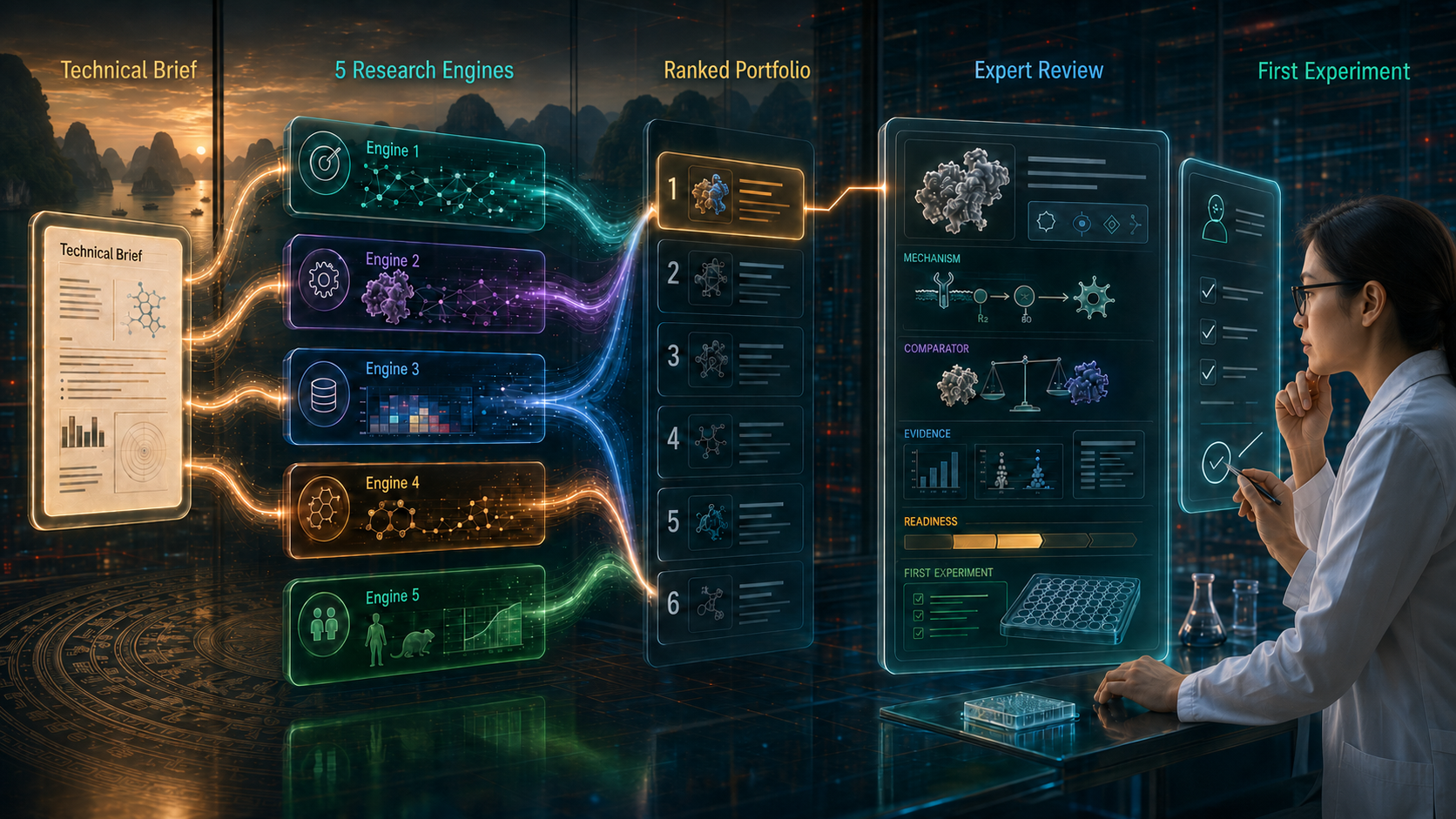
The difficult part of research ideation is rarely producing another suggestion. It is finding a direction that is sufficiently different to matter, technically credible enough to pursue and concrete enough to test. ScopeIdea, a web-based research ideation platform, is designed around that harder task.
Rather than returning a loose list of AI-generated possibilities, the platform turns a technical brief into a ranked portfolio of research concepts. Each selected concept is meant to show how the idea would work, what it should be compared with and what experiment could begin to evaluate it. ScopeIdea is already publicly accessible, although its ability to improve research outcomes has not yet been independently benchmarked in the materials reviewed for this article.
The platform grew from a familiar problem in laboratories and research organizations. Scholars can spend weeks surveying adjacent fields, testing combinations and discussing whether an idea is genuinely new or merely sounds new. General-purpose AI can accelerate brainstorming, but a fluent answer does not automatically expose a mechanism, distinguish evidence from inference or tell a team what to do next.
"Generating ideas is easy. Generating ideas that are genuinely non-obvious, technically credible, testable, and worth pursuing is much harder."
— Khaled N. Salama, VinUni professor and ScopeIdea creator. Article authored by Khaled Salama, V-SENSE Founding Chief Scientific Officer.
The distinction matters because an appealing research direction still has to survive comparison with prior work, available evidence and practical constraints.
ScopeIdea organizes that reasoning as a staged workflow. Five specialized research engines examine the same brief in parallel from different perspectives, including routes based on neighboring research and cross-domain analogies. Their strongest candidates are combined and assessed rather than simply appended into one long brainstorming list. Users can choose among Practical, Balanced, Blue Sky and Rupture modes, which change the level of ambition sought from the search.
The evaluation layer considers six dimensions: novelty, potential impact, feasibility, supporting evidence, fit to the stated gap and clarity of execution. The result is a ranked set of research cards rather than an unstructured answer. The public interface allows users to request between one and seven ideas, giving them some control over the breadth of the output and the time needed to review it.
Each surviving idea is developed into a testable concept. Public descriptions of the platform say that a card includes a technical mechanism, an explicit comparator, a validation pathway, a readiness assessment and a decisive first experiment. These fields force useful questions into view. What causes the predicted result? Against which baseline should it be judged? What observation would justify continuing, revising or stopping?
Consider a proposed sensor as an illustrative case. Naming a new material would not be enough. A research-ready card should explain how the target interacts with that material, how the interaction produces a measurable signal, which existing sensor provides the relevant baseline and which controlled experiment could distinguish the proposed mechanism from a competing explanation. The same discipline applies across fields: the output should connect a claim to an observable result.
That structure could help several kinds of users. A doctoral student may use it to move from a broad topic toward a defensible experiment. A principal investigator may compare several mechanisms before committing laboratory resources. Research and development teams may use the ranked portfolio to document why one direction advanced while another did not. Promising concepts can also be exported as structured reports or developed into proposal drafts, according to ScopeIdea's public introduction.
These outputs should not be confused with verified discoveries. A score orders concepts according to stated criteria; it does not establish that the highest-ranked idea is correct or new. ScopeIdea describes itself as a decision-support system, not a replacement for literature review, domain expertise, experimental judgment or authorship. Evidence labels and comparators can make scrutiny easier, but researchers still need to check cited work, test assumptions, assess safety and confirm novelty before acting on any recommendation.
The next important evidence should therefore concern the platform itself. Controlled evaluations could compare ScopeIdea with conventional brainstorming and general-purpose AI on the novelty, technical validity, diversity and testability of blinded idea portfolios. Studies could also measure how often experts reject unsupported claims and whether different users reach consistent judgments.