Where hardware becomes intelligent
The missing layer between smart algorithms and lived environments.
Three research pillars, one engineering standard, and the first pilots putting it to work. This is the full picture of how V-SENSE builds self-aware sensing systems.
The smartest infrastructure doesn't need more sensors—it needs smarter sensors.
The three pillars
Embedded Hardware and Software Systems
Sensing interfaces, low-power readout electronics, wireless sensor nodes, and environmental packaging — the core engine behind every self-aware diagnostic. This pillar builds the physical devices that every other pillar depends on.
- ·How does a sensor detect its own drift before it corrupts a downstream decision?
- ·What
- ·How do you package electronics to survive years in a hospital, home, or vehicle?
Validation, Trust & Human Factors
Comparator studies, field validation protocols, signal-quality scoring, and failure-mode characterization that hold hardware to a clinical-grade standard — plus the human factors research that determines whether people actually trust and adopt it.
- ·What
- ·How do you quantify confidence so it means the same thing to an engineer and a clinician?
- ·What makes a patient, clinician, or occupant actually trust — and adopt — a sensing system?
Translation & Business Models
Partner pilots, licensing, startup formation, and Vingroup deployments — turning technical achievement into institutional impact by matching each validated platform to a viable path to market.
- ·Which validated platforms are ready for a real deployment, and with which partner?
- ·Does this technology become a license, a spinout, or an internal Vingroup product?
- ·What does a phased, evidence-based rollout across a hospital or campus look like?
Our Translation Engine
From silicon to city-scale deploys—V-SENSE accelerates hardware development through an exclusive triple-helix operational model, leveraging the full VinGroup ecosystem.
Initial hardware concept, mixed-signal CMOS design, and memristor array emulation handled entirely within the V-SENSE core laboratories. Proof-of-concept validation on prototype benches.
Direct sandboxed hardware stress-testing utilizing Vinmec Healthcare facilities for physiological sensors and Vinhomes structural footprints for radar and environmental modules. Real-world deployment trials.
Immediate pilot manufacturing and deployment scaling powered by the broader VinGroup ecosystem. Bridges the gap between prototyping and mass industrial IoT rollout across healthcare, real estate, and commerce verticals.
How Research Pillars Guide Our Pilots
Each pilot project applies our research pillars in different ways. Explore which pillars drive each pilot's design and implementation.
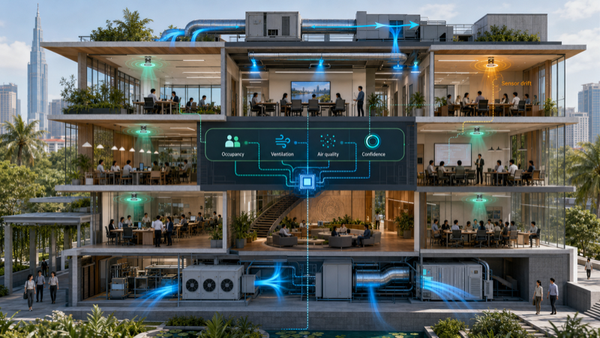
Smart Buildings & Indoor Environmental Quality
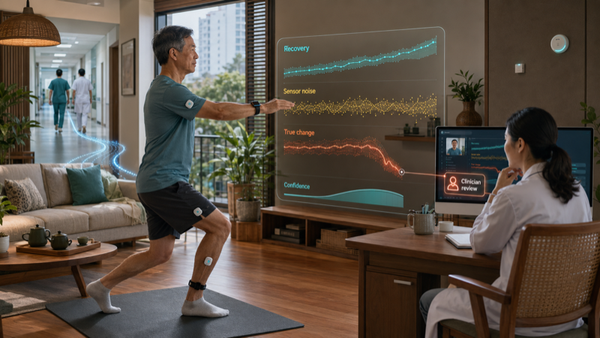
Hospital-to-Home Rehabilitation Sensing
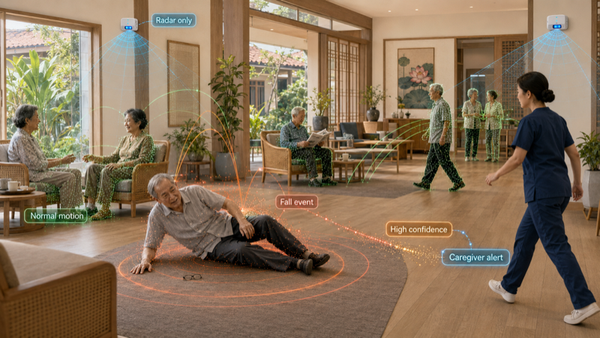
Smart Homes & Aging-in-Place
The high cost of silent failure
In the real world, sensors drift, calibrations fail, and installation conditions vary. When hardware misrepresents air quality or misses physiological deterioration, the result is a total breakdown of trust between technology and the people who depend on it.
The most dangerous sensor is one that fails in silence.
Four pilots, one mission
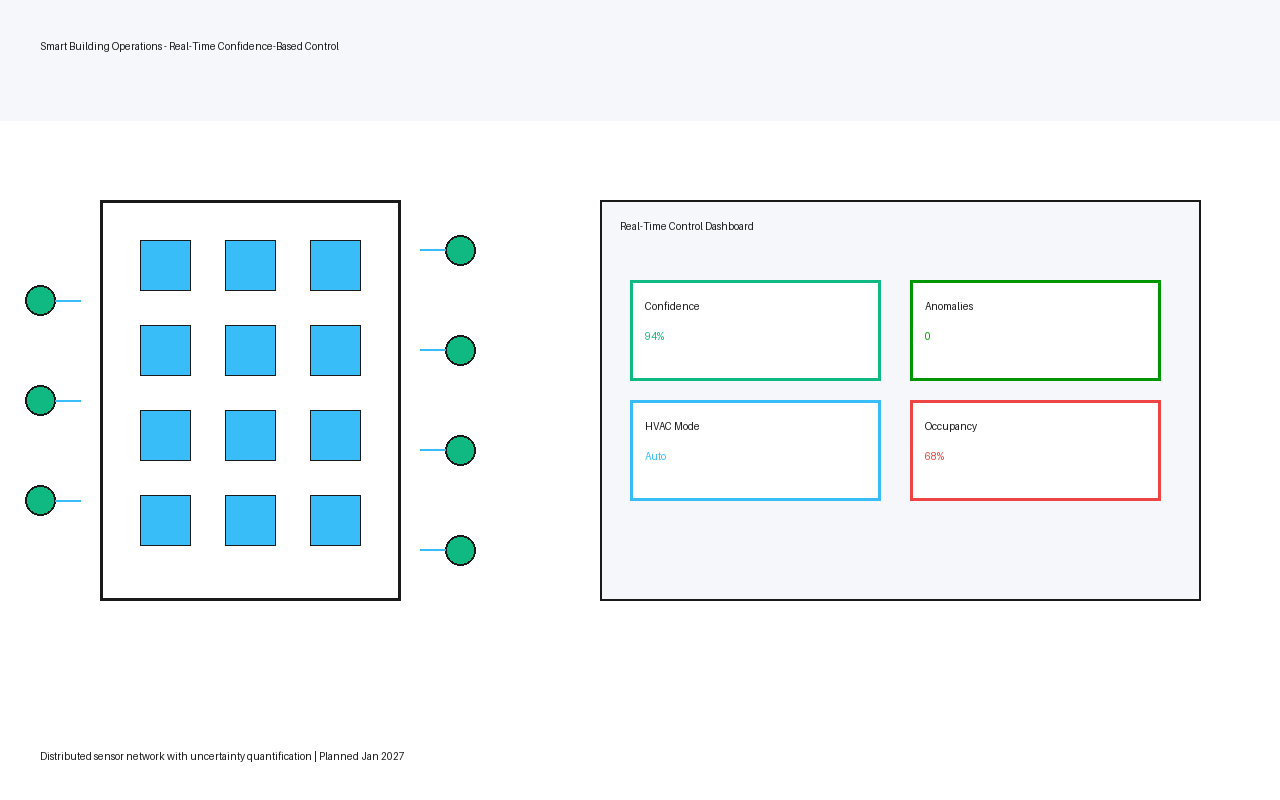
Every pilot ships with mandatory self-aware sensing and is overseen by V-SENSE. From buildings to hospitals, homes, and decision-support systems.
Three core engineering vectors power every pilot
Self-aware CMOS circuits, neuromorphic edge computing, and adaptive RF sensing—plus an interactive algorithm simulator to explore how uncertainty quantification works in real-time.
Explore Core Frontiers & Algorithm →Built on RISE
Robustness, Integrated architecture, Self-aware diagnostics, Ecosystem-driven validation—the four principles guiding every platform V-SENSE builds.
Hardware engineered for high-stress, non-laboratory environments, where failure is not an option.
A seamless stack spanning sensing interfaces, edge-AI signal acquisition, and on-device intelligence.
On-device health monitoring that quantifies uncertainty and reports confidence alongside every measurement.
Binding access to the Vingroup operational ecosystem to stress-test and iterate every platform we produce.
Trust is a level, not a label
The Validation and Trust Readiness Level (VTRL) is a proposed V-SENSE framework that measures whether a platform is trustworthy under real-world conditions — replacing subjective claims with an auditable engineering standard.
Trust becomes an engineering output, not a post-hoc interpretation.
Reference comparator identified. Uncertainty model quantified. Calibration-failure detection demonstrated on bench.
Reference comparator co-deployed. Signal-quality scoring applied. Failure-mode inventory documented. Ethics clearance in place.
Independent multi-site replication. Inter-site variability characterized. Governed datasets archived. Full data-governance audit complete.
A facility built for the work, not a demo bench
Two cores — Biosensing & Bioanalytical and Instrumentation — sharing fabrication, electrochemistry, optics, and high-speed instrumentation under one roof.
Explore the facility →Publications
As a founding-year institute, our published research is just getting underway. Papers, preprints, and patents from V-SENSE labs will appear here as they
No publications yet — check back as our first research cycle completes